
Got a flat?
Flat tyre: what to do, step by step
Flat tyre? What to do first is get the car somewhere safe and stop driving on it. Then send us a photo of the tyre: we tell you whether it can be repaired, give you the price and a real arrival time, and come to the car, wherever it's stopped, 24 hours a day.
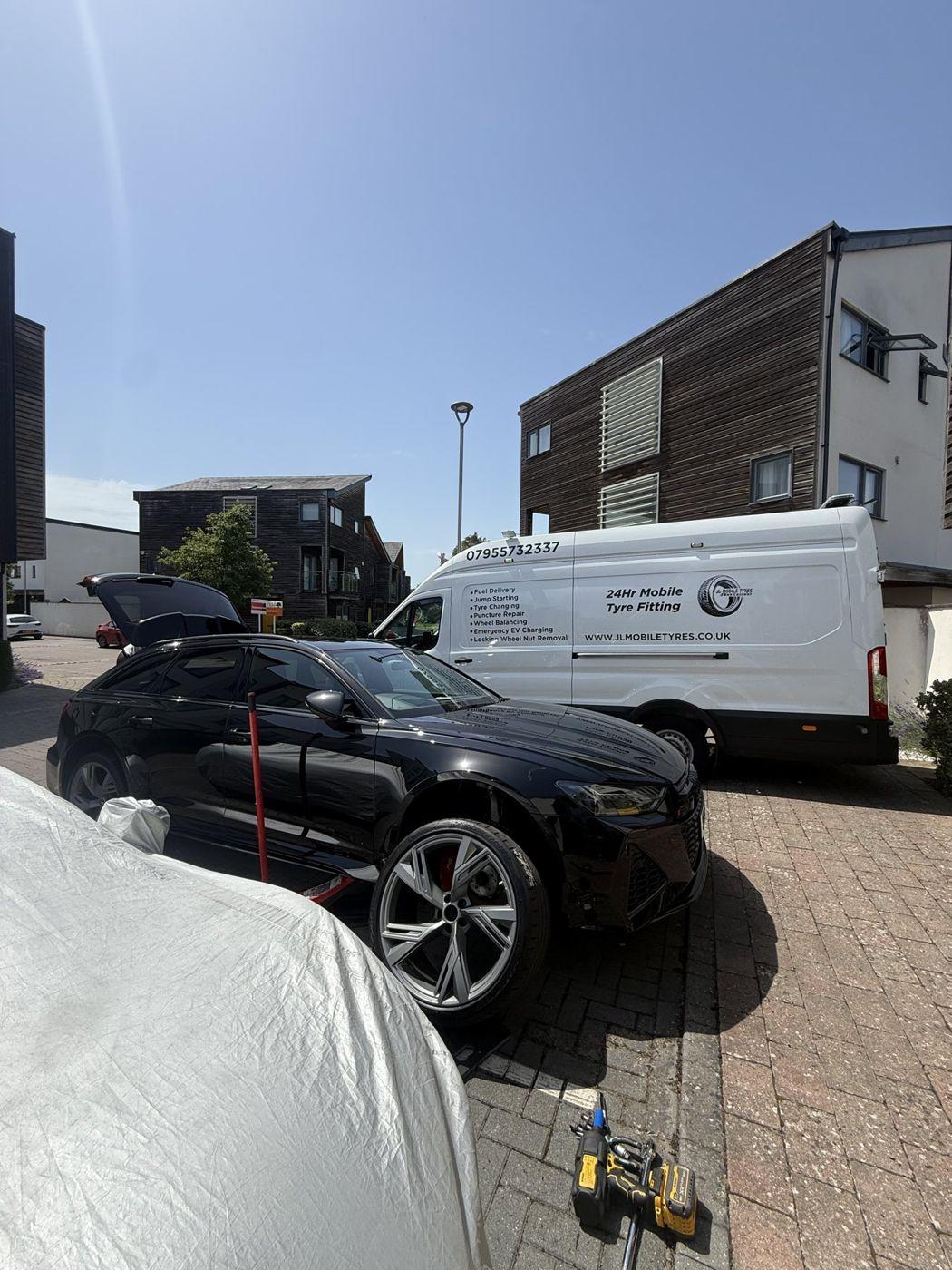
- Stop safely: off the road if you can, hazard lights on, nobody standing between the car and the traffic
- Don't drive on it flat: damage from driving under-inflated is one of the reasons a tyre can't be repaired
- Send a photo of the puncture and the sidewall on WhatsApp, so we know before we set off if it's a repair or a new tyre
- Repaired at the car from the inside to BS AU159, usually 15 to 30 minutes once we're with you
- Or a new tyre in any brand and size, fitted where the car is parked
Stop somewhere safe first
If a tyre goes while you're driving, grip the steering wheel firmly and let the car roll to a stop at the side of the road. That's the Highway Code's advice when a tyre bursts, and it's the right start for any flat you feel on the move.
Once you've stopped, the Highway Code's breakdown rule says:
- Get the car off the road if you can.
- Use your hazard lights if the car is in the way of other traffic.
- Don't stand, or let anyone else stand, between the car and oncoming traffic.
- If you carry a warning triangle, put it at least 45 metres behind the car on the same side of the road, taking great care. Never use one on a motorway.
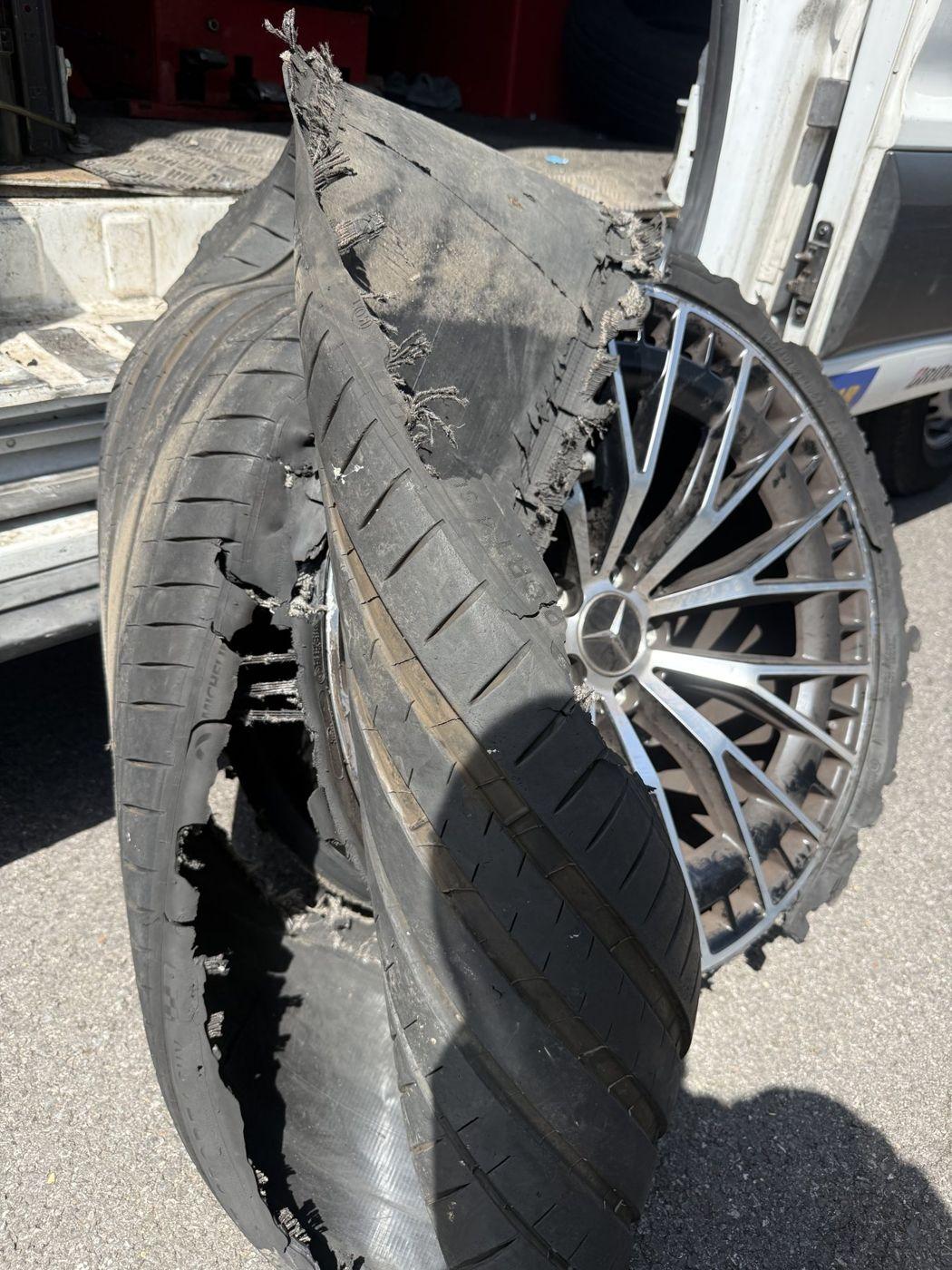
On a motorway, the rules change
Leave at the next exit or pull into a service area if you can. If you can't, stop on the hard shoulder or in an emergency area, get out on the side away from traffic and wait behind the barrier.
Don't change the wheel there: the Highway Code says not to attempt repairs on your car on a motorway. Our guide to a flat tyre on the motorway takes you through each step, including who to call and how to tell them where you are.
Have a look: puncture, slow leak or damage?
Once you're safe, look at the tread and both sidewalls. What you find decides what happens next.
- A nail or screw in the tread. It's the message we get most: "I have a nail in the middle of my tyre." Leave it in for us. TyreSafe says a fitter may be able to take it out and repair the hole, and where it sits tells us whether that's possible. See nail in tyre: can it be repaired?
- A tyre that keeps going down. If it loses air over days rather than minutes, it's a slow puncture. A small nail is one cause and a perished valve is another; we repair the first and replace valves at the car.
- A cut, crack or bulge in the sidewall. That can't be repaired; see tyre bulge and sidewall damage. TyreSafe says repairs can only be made in the central three-quarters of the tyre, so damage on or close to the sidewall means a new tyre.
- A warning light and nothing to see. Check the pressures in all four tyres, cold if you can, because warm tyres can give a misleading reading. The Highway Code says under-inflated tyres affect your brakes and steering.
- Run-flat tyres. The car may keep going after a puncture, but we don't repair run-flats: repairing them isn't generally advised, so we fit a new one. What the tyre makers say is in can a run-flat tyre be repaired?, and how to tell if you have them is in what is a run-flat tyre?
Why you shouldn't drive on a flat
Stop as soon as it's safe, even if a garage is only round the corner. With no air in it, the tyre is squashed between the wheel and the road. TyreSafe lists damage caused by under-inflation among the reasons a tyre can't be repaired, so a nail that would have been a quick repair can end up as a new tyre. More on that, and how far is too far, in can you drive on a flat tyre?
That's the point of a mobile fitter. You don't move the car: we come to it, and the tyre stays where it is until we take it off the wheel.
Run-flats are built to get you somewhere safe at reduced speed, within limits set by the tyre maker. Your handbook gives your car's figures.
Spare wheel, space saver or sealant kit?
Look in the boot, and under the boot floor, before you decide what to do.
- A full-size spare. If the car is off the road somewhere safe and you know how, you can fit it, and we'll repair or replace the punctured tyre later at home or work. Never on a motorway hard shoulder.
- A space saver. The thin temporary wheel. TyreSafe says you're usually limited to 50 mph in dry conditions and should avoid motorways and dual carriageways where you can. It's only meant to get you somewhere a proper tyre can be fitted, so check your handbook for your car's limit.
- A sealant and compressor kit. Many cars carry one instead of a spare. TyreSafe says these give a temporary fix for about 80% of punctures, that you should drive a short distance slowly before joining a busy or fast road, and that the tyre should be replaced at the earliest convenience. If you've used one, tell us when you call.
- Nothing at all. Don't drive on it. Call or WhatsApp us and we bring the tyre shop to you.
Repair or new tyre: the photo tells us
Not every puncture can be repaired, so we ask for a photo before we set off. Send us one of the puncture and one of the sidewall on WhatsApp, with your tyre size, where you are and your locking wheel nut details, and we'll tell you straight whether it's a repair or a new tyre, and what it costs.
A proper repair can't be done with the tyre still on the wheel. TyreSafe says permanent repairs can only be made once the tyre is off the wheel, so it can be checked inside as well as out. That's how we work: in the van beside your car, the tyre comes off, the puncture is repaired from the inside with a mushroom patch to BS AU159, and the wheel is balanced before it goes back on.
If the same puncture lets you down within 3 months, we come back and re-fix it free, and a proper repair like this is permanent: see how long a puncture repair lasts. Our page on mobile puncture repair explains what decides whether yours can be repaired.
If it can't, we fit a new tyre at the car, in any brand and size for cars, vans, 4x4s and SUVs, and take the old one away at no charge.
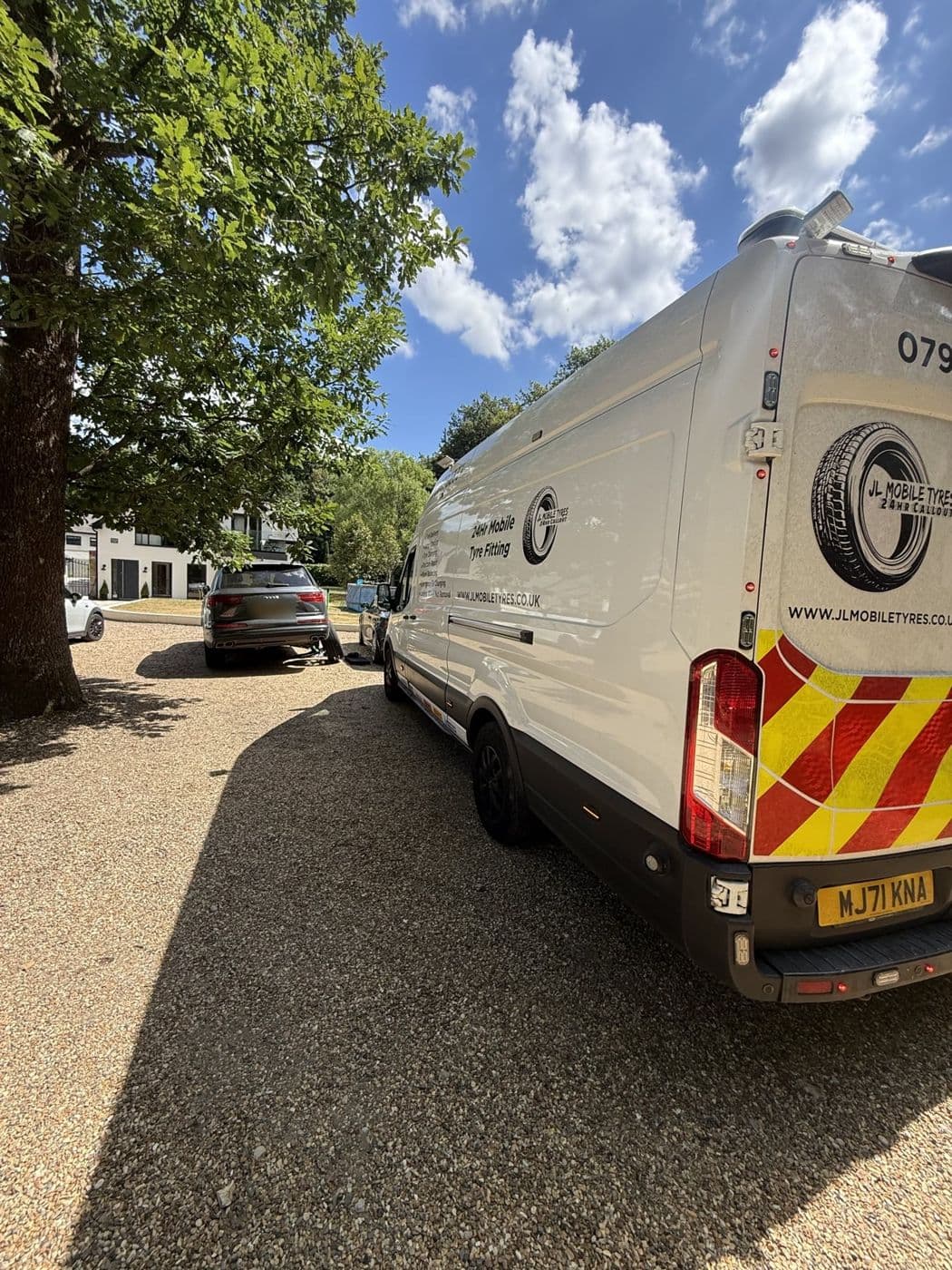
Getting it fixed where the car is
We run 2 vans from Bromley, 24 hours a day, 7 days a week, across south east London, Surrey and Kent. You don't need to move the car.
- On your drive or at work: if the car is parked safely and you can wait, book a time. A booked call-out costs less than an emergency one.
- Stuck right now: call or WhatsApp us for emergency tyre fitting. We leave straight away, with no extra charge at night or at weekends.
- At the roadside or on a motorway: we fit tyres at the roadside and on the hard shoulder of the M25, M20, M26, M23, M2, M3, M4, M27, M271, M275 and A3(M). See roadside tyre repair.
- In a car park: we repair and fit there too, with the work done in the van parked beside your car.
How long it takes
You get the price and a real arrival time before the van leaves. In our core area we're usually with you in 30 to 60 minutes; further out, we tell you the real time when you call, and the driver rings with updates on the way.
A puncture repair takes 15 to 30 minutes once we're with you. A tyre change usually takes 60 to 90 minutes from your call to driving away in our core area. Before you go, the wheel is torqued to the manufacturer's figure and the TPMS reset with you.
What a flat tyre costs to sort out
A puncture repair is from £20 plus the call-out. If it needs a new tyre, the call-out is from £80, plus the tyre. A booked job costs less than an emergency one.
If a locking wheel nut has to come off without its key, removal is added to the total, which is why we ask about it before we set off. You pay the driver by card, cash or bank transfer. The full breakdown is in what mobile tyre fitting costs.
Need it sorted now?
Puncture repair, at your car
FAQs
More questions
Anything else? Call us. It's quicker than reading.
Does a flat tyre always mean a puncture?
No. A tyre can also lose air through a perished valve, or be let down by a cut in the sidewall. Send us a photo and we'll tell you what we're looking at before we set off.
How much does it cost to repair a flat tyre?
From £20 plus the call-out for a puncture repair, if the photo shows it can be repaired. If it needs a new tyre, it's from £80 for the call-out plus the tyre, and you get the exact price before we set off.
Can you fix a flat tyre at home?
Yes. We repair or replace it on your drive, at work or in a car park, with the work done in our van beside your car. You don't need to take the car anywhere.
How long does it take to fix a flat tyre?
A puncture repair takes 15 to 30 minutes once we're with you. A tyre change usually takes 60 to 90 minutes from your call to driving away in our core area.
Should I take the nail out of my tyre?
No, leave it for us. TyreSafe says a fitter may be able to take it out and repair the hole, and where it sits tells us whether that's possible, so send us a photo first.

Flat tyre right now?
Call or WhatsApp. You'll get a price and an arrival time before we set off.